
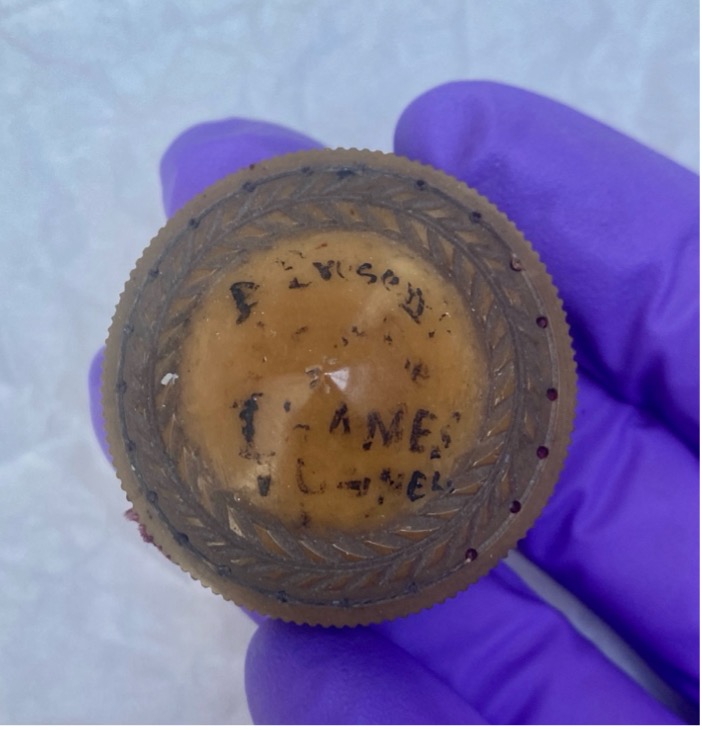
This is a pincushion made of carved tagua nut, so-called ‘vegetable ivory,’ joined by a cushion of red fabric. On one side is a partly-legible legend ‘Present from the Thames Tunnel’.
‘Vegetable ivory’ is made from one of several varieties of plant, almost all of which grow exclusively in South America, the seeds of which are strong enough to be carved and which bear a passing resemblance to elephant ivory (from which it is distinguished in part by a more ‘oily’ surface texture). These seeds were widely used in an era before the manufacture of plastics for small, decorative objects (notably buttons).[1]
The use of ‘vegetable ivory’ for this kind of pincushion appears to have been fairly novel and associated with a particular stallholder in the Tunnel, one ‘Mr. Langston,’ as reported in The Times on 14 September 1843:
In commemoration of Her Majesty [Queen Victoria] and Prince Albert’s visit to the Thames Tunnel, on the 26th of July [1843], Mr. Langston, who occupies some stalls in the tunnel, manufactured a pincushion, of what he terms ‘vegetable ivory,’ for presentation to Her Majesty. The pincushion, composed of rich crimson velvet, was in the form of a coronet, surmounted by the Royal crown, both which and the stand, together with the work round the pincushion, were formed of ivory, and executed in the most delicate and beautiful manner. On one side of the pincushion was carved on the ivory a view of the entrance to the Tunnel, and on the other the words, ‘A Present from the Thames Tunnel,’ surrounded by wreaths. On being finished, the pincushion was enclosed in an elegant puce [sic, scil. pure] morocco case, lined with white satin, accompanied by a description of the vegetable, of the nuts of which this ivory is composed, printed in letters of gold on blue satin.[2]
A number of ‘vegetable ivory’ objects used in sewing/embroidery were produced and sold in the Tunnel: alongside pincushions are often found étuis of various types. Specifically gendered items, they may speak to a female audience amongst Tunnel visitors.