
Shota Noonan, a student at the Architectural Association School of Architecture, has been conducting a project entitled Notes from a Forgotten Island, which included a residency at the Brunel Museum in which he engaged individuals, asking them to define their perceived boundaries of Rotherhithe and evolving into deeper discussions about identity, memory, and change. The results of Shota’s work will form the basis of a new zine, Common Ground, and will be presented at the Museum on 6 May 2026.
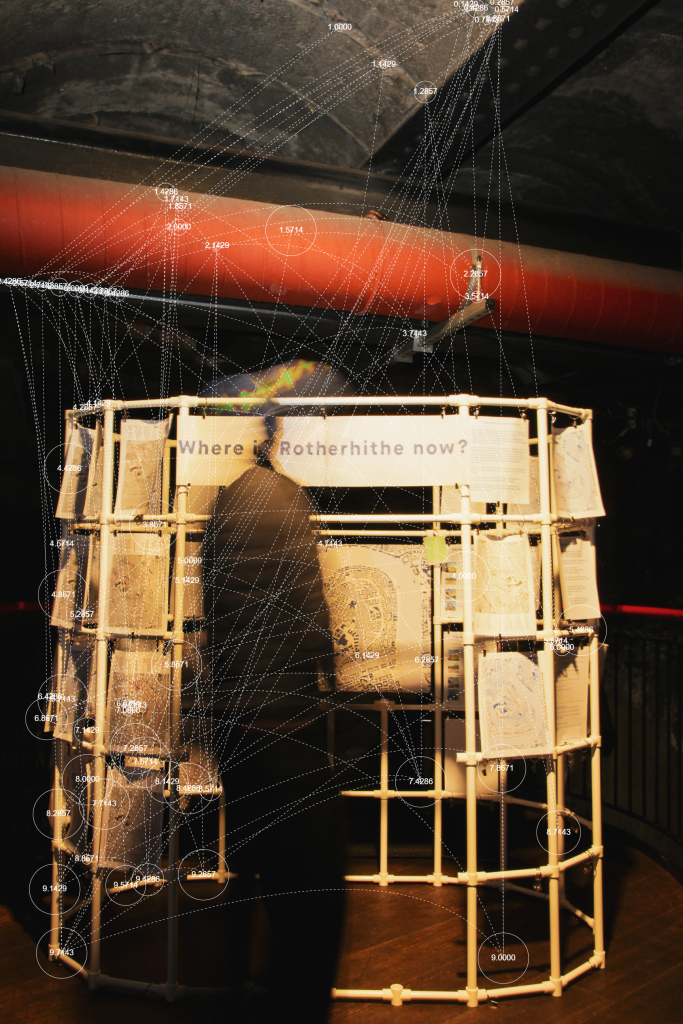
My name is Shota Noonan, and I am working in collaboration with Diploma 2 at the Architectural Association School of Architecture. My overarching project title, Notes from a Forgotten Island, is grounded in Rotherhithe and explores how spatial practice can support the emergence of a contemporary commons. A commons is created and sustained by communities, which involves a common pool of resources that are not commodified. In years before this could come in the form of a town’s water supply from a reservoir and now we have things like Wikipedia as a knowledge commons. Our commons forms along the lines of a commons where there is a resource that the Rotherhithe community will be able to freely use to create a change to physical landscape through design. Through practical engagement output, Common Ground Zine, operates as both a tool to unlock new knowledge and as an evolving record of engagement.
The project began with an initial mapping session at the Dockland Settlement Centre alongside Emilie Mendy, whose long-standing involvement in local community work provided an entry point into the area. This session surfaced a series of underlying issues, revealing a fragmented landscape of local initiatives and a lack of shared infrastructure to connect them. From this, and informed by both theoretical readings on the commons and tutors’ practical experience, I built a knowledge matrix, a system of related trials and tensions that exist here in Rotherhithe, whether that relates to individuals or to regulatory conflicts, to map the conflicts that prevent a commons from forming. Unsurprisingly, access to funding emerged as a central barrier.
Rotherhithe, geographically defined by its peninsular condition along the Thames, became both site and subject. My research question – how to finance and give agency to bottom-up projects through a commons – initially drew on commons-based peer production. I tested a model where local residents co-produced artwork for sale, generating capital for collective use. While this approach proved somewhat naïve, it established a critical testing ground. Through continued engagement, the project shifted focus toward the relationship between institutions and local artistic practice, particularly the potential of residency models.
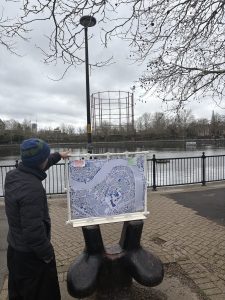
A key precedent was the Rotherhithe Public Living Room project (RPLRP), which some of you may remember from 2019 at the Gas Holder site. Demonstrating how structured participation could mobilise local voices. From this, I adopted the artist residency as a framework for engagement. Central to this was the design of a mobile, adaptable structure that could act as both spatial anchor (something real and tangible that could be used to understand the project for the local public) and epistemic tool (a tool to learn from the environment, both human and built surroundings) – facilitating the uncovering of tacit local knowledge.
The resulting structure, composed of 3D-printed connectors and PVC pipes, is lightweight, collapsible, and reconfigurable. Its form references the gas holder, the significant local symbol of the RPLRP, while its function remains open-ended. Scaled to accommodate A4 sheets, it allows contributions – drawings, writings, mappings – to be displayed as part of an evolving, collective exhibition. Its mobility proved crucial, enabling access to institutions without requiring long-term commitment, thereby lowering barriers to collaboration.
This culminated in a week-long artist residency at the Brunel Museum, following 136 hours of prior engagements. Here, the structure occupied multiple sites, from the plaza to the tunnel shaft, facilitating conversations with local participants. Initial prompts asked individuals to define their perceived boundaries of Rotherhithe, but these evolved into deeper discussions about identity, memory, and change. As interactions unfolded, the structure itself adapted, both physically and socially, mediating between institutional authority and informal exchange.
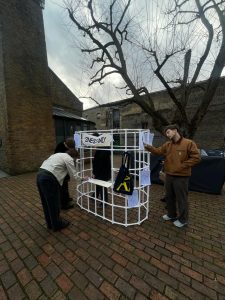
One key observation was the tension produced by shifting demographics since the closure of the docks, manifesting in both spatial and class divisions. Yet across these differences, shared concerns and common ground persisted. The residency also revealed the importance of trust: operating within an institutional setting initially lent credibility, while opening the structure to occupation allowed conversations to detach from that authority and deepen.
It is often difficult to translate the wealth of information provided through person-to- person conversation and it is the challenge that this project is currently navigating. Opening up all the findings of this project at an open forum on the 6th of May, we will utilise smarter technologies to make sense of all your local sentiments without the introduction of bias. The presentation will outline a proposal of a new model of design that creates new paths for funding for bottom-up projects with the power for every local participating to have a real impact on any changes.
To discover the results of Shota’s project, please join us for a special presentation in the Museum’s Tunnel Shaft, on Tues 6 May from 17.30-18.30. You can book your free ticket below: