
Following the completion of an internship and research project at the Brunel Museuas part of her MA in History at Queen Mary University London, Naima El Halili Kintlerova explores the intersection of empire and the Thames Tunnel.
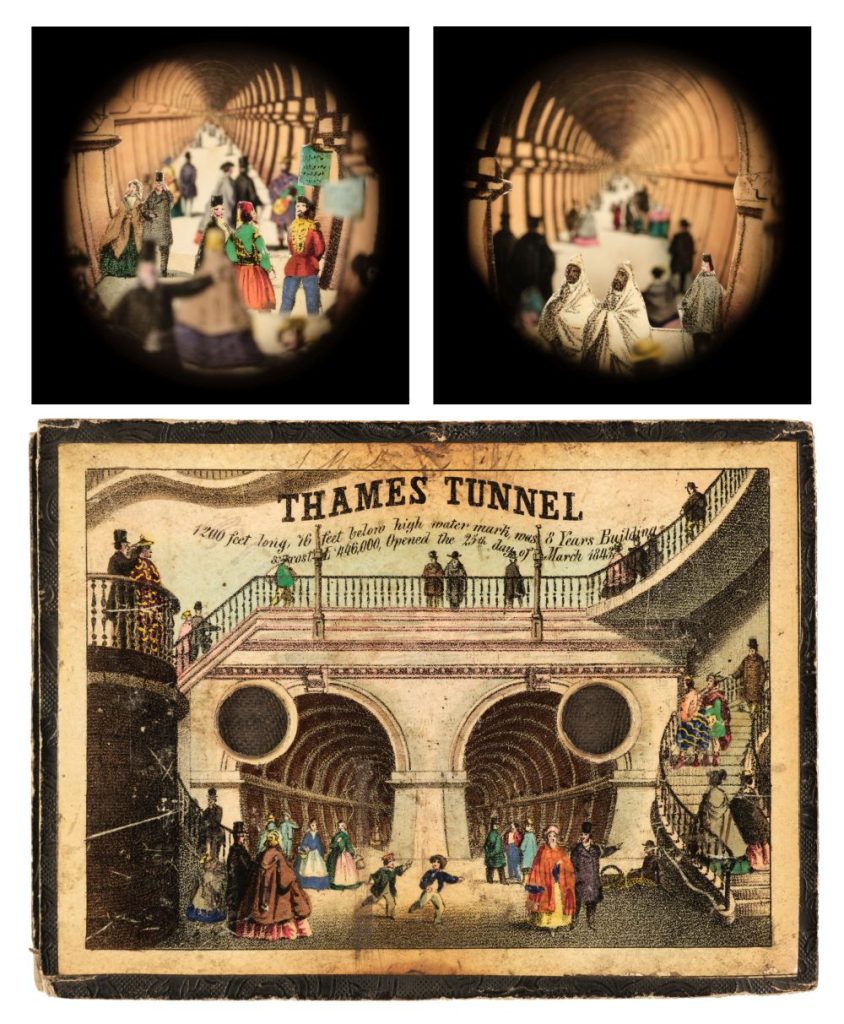
Thames Tunnel peepshow, sold at Dominic Winter Auctions from the collection of the Library of the Late Christopher Foyle of Beeleigh Abbey (27 Sept 2023, Lot 287)
As you descend into the Thames Tunnel Shaft on 26 July 1848, the music and voices of visitors moving through the Grand Fancy Fair grow louder. Some complain of their long day, others discuss in amazement the paintings they had just observed in the Royal Cosmorama – the centrepiece of this Fancy Fair. You approach one of the lenses set out in the shaft which faces a painting labelled Marketplace in Messina, Sicily. Peering through the lens, you are immediately transported into the Sicilian market as the painting now appears three-dimensional. Whilst visitor accounts are scarce, this is how we can imagine an evening at the Thames Tunnel’s Royal Cosmorama would have begun.
Narratives of the Thames Tunnel – the world’s first tunnel beneath a river – often concentrate on the enormous engineering feat it represented. Whilst the Thames Tunnel remains a remarkable achievement for its time, this focus on technology in isolation often leaves its entanglements with empire unexplored.
As part of my History MA at Queen Mary, University of London, I was lucky enough to undertake an internship with the Brunel Museum. My research culminated in a public history workshop – Mapping Global Movement to the Thames Tunnel – which traced journeys and distances that led the likes of Ottoman politician Ibrahim Pacha and a group of Ojibwe indigenous Americans to the Thames Tunnel. By focusing on the understated social and cultural life of the Thames Tunnel, my workshop highlighted diverse presences in the Thames Tunnel and Victorian London more broadly, and spotlighted global and imperial connections.
These entanglements were clearly illuminated to me by my discovery of an advertisement for a Cosmorama which took place in Thames Tunnel Shaft from 26 to 28 July 1848.[1]
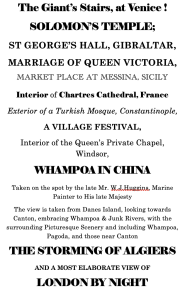
List of paintings as advertised on the Royal Cosmorama advertisement
What are cosmoramas?
Offering a “Picturesque Promenade Around the World,” the first cosmorama was first promoted by Italian churchman Jean-Antoine-Henri-Eugène Gazzera in Paris in 1808.[2] In a cosmorama exhibition, paintings were typically placed behind a wall, only available to view through a lens.[3] Special lighting and magnifying lenses transformed produced an immersive three-dimensional viewing experience by creating the illusion of depth.[4] This was an early form of virtual travel that allowed audiences to be transported to far corners of the world without physical displacement and the expensive cost.
The Thames Tunnel cosmorama was no different. For the low price of two-pence, audiences journeyed from Queen Victoria’s Chapel in Windsor to Solomon’s Temple, even finding themselves at the Storming of Algiers, all in one evening.
Cosmoramas, Eurocentrism, and Empire
Broadly, the Cosmorama advertisement solidifies the Thames Tunnel as a cultural site and informs on the variety of entertainment available to the Victorian public on the tunnel. However, looking more closely at the document and considering the role of exhibitions in reaffirming imperial narratives spotlights undercurrents of empire which were deeply woven into British culture, not excluding the Thames Tunnel.
Popular Victorian art mediums, such as the panorama and cosmorama, had strong links to empire.[5] After all, many of the featured art pieces would have been depictions of places reached due to imperial and economic expansion. Moreover, cosmoramas offered a journey around the world through the imperial state’s eyes, privileging European events, locations, and interests. Technical aspects of the display further reinforced identification with an imperial viewpoint. The positioning of the lens, for example, gave viewers a privileged central perspective: this offered a sense of ‘visual dominance,’ encouraging an authoritative gaze aligned with imperial power. This all placed the public within workings of power, framing them as beneficiaries of empire and produced a Eurocentric view of the world.[7]
The 1848 Cosmorama advertisement cited above demonstrated the educational element of exhibitions in nineteenth-century Britain as it described the event as ‘instructive’ and offering ‘a vast field of information.’ Blending entertainment and education, the Royal Cosmorama provided both historical and moral instruction as it conveyed global landmarks, recent colonial acquisitions, the 1816 Bombardment of Algiers, and Britain’s global presence.
Cheap entry prices allowed this education to traverse class boundaries. This spotlights a civilising mission aimed at the British working-class alongside the colonial mission unfolding internationally. With growing concerns with poverty and the ‘problem of leisure’ – ‘drinking, gambling, prostitution or “idleness” – Victorian social reformers promoted exhibitions, made more accessible through cheap ticketing and varied opening times, as an ‘alternative leisure provision.’[8] This kept the working-class away from morally dubious habits, engaging them with art, an ‘elevating force,’ and ensuring social control.[9] The Thames Tunnel became a cultural location in which widely shared imperial understandings, identities, and social norms could be consolidated.
Whampoa in China

William John Huggins, ‘Whampoa in China,’ 1835, via Wikicommons
The imperial dynamics of the cosmorama can be seen in its inclusion of the painting Whampoa in China, a key trading port in Hong Kong which, when the Cosmorama was advertised in 1848, had just been acquired following the British victory in the First Opium War (1839 – 1842).
Depicting a calm port, Whampoa in China signalled the extensive global reach of the British empire with the British flag prominently placed within the visual landscape. This peaceful portrayal of the port is also particularly striking considering that, just years prior in 1841, it had been the site of The Battle of Whampoa.
The Cosmorama allowed the public, for a cheap price, to experience colonies at the Thames Tunnel without making the expensive and arduous journey to Hong Kong. Hence, colonies were suddenly not remote lands, but places that attendees albeit in an indirect and arguably sanitised manner. Viewed through a lens, this immersive and somewhat private experience encounter allowed for empire to feel more immediate and ‘lived.’
The Storming of Algiers
#/media/File:Thomas_Luny_-_Bombardment_of_Algiers.jpg)
Thomas Luny, ‘The Bombardment of Algiers’, 1820, via Wikicommons
Imperial moral identities were also consolidated in the Cosmorama as it reminded attendees of the Bombardment of Algiers. There are many depictions of the Storming of Algiers, and it is unclear which exact painting was displayed at the Thames Tunnel. However, all portrayals present similar scenes to that above: a naval battle waged in 1816 by the Dutch and British against Omar Agha, the Dey of Algiers, to end the enslavement of Europeans.
Considering the abolishing of slavery in the British Empire through the 1833 Abolition Act, resurfacing the Bombardment of Algiers in the public consciousness supported imperial sentiments of imperial superiority. Reinforcing perceptions of non-European ‘barbarism,’ the Cosmorama contributed to the formation of a shared moral code which upheld the imperial ‘civilising mission.’ Bringing this battle to the audiences through an immersive experience in the Thames Tunnel – a symbol of British modernity – would have likely enhanced the public’s sense of involvement in wider national and imperial narratives.
The contrasting depictions of Whampoa in China, a successfully ‘tamed’ land, and The Storming of Algiers, a violent naval battle fought alongside European allies, convey two complementary sides of the British Empire, both emphasising naval prowess. Held in the Thames Tunnel – an engineering project which symbolised mastery over the sea – the Cosmorama reinforced Britain’s naval imperial identity and its position as a global maritime power in the public consciousness.
Cultural diplomacy
As well as echoing imperial ideologies, paintings in the Thames Tunnel Cosmorama, specifically Exterior of a Turkish Mosque, Constantinople, also showcased international diplomatic relations.
In the early nineteenth century, Britain cultivated a strategic relationship with the Ottomans which increased its economic influence within the Ottoman empire and ensured a buffer zone which discouraged attacks on India by France and Russia.[10]
The use of art exhibitions to foreground British-Ottoman diplomacy was not unprecedented. In fact, to celebrate their allyship in 1801, a panorama of Constantinople was displayed in Leicester Square.[11] Within this context, this inclusion can be read as a subtle nod to British-Ottoman relations.
Whilst the mosque depicted is not stated to represent an identifiable landmark, its presence in the Thames Tunnel Cosmorama nonetheless communicates to the public Britain’s far-reaching global presence. Additionally, it reflected tensions within imperial logic. While this inclusion indicated diplomatic cooperation and alliance with the Ottoman Empire, the wider cosmorama continued to present Britain through a framework of moral and cultural superiority.
International visits

Charles-Philippe Larivière, ‘Ibrahim Pasha of Egypt,’ 1846, via Wikicommons
Beyond the paintings, the Cosmorama advertisement also cited royal visits including Ibrahim Pacha of Egypt’s – Ottoman Governor and Commander of Egypt – 1846 visit to London and the Thames Tunnel. In his unexpected visit to the Tunnel, according to the Daily News report, Ibrahim Pacha showed great curiosity by inspecting the Tunnel and asking ‘innumerable questions.’[12]
It was the listing of this visit which prompted my focus on diverse presences within the Thames Tunnel. By referencing this visit, the advertisement spotlighted the global and noble intrigue it attracted and reinstated the Tunnel’s status as “The Eighth Wonder of the World.” In addition to being a cultural site, the tunnel performed a diplomatic function as it was integrated into state tours.
Interacting with Empire in the Thames Tunnel
The cosmorama advertisement was just one facet of my project, Mapping Global Movement to the Thames Tunnel, but a significant one which revealed how the Thames Tunnel was not only an engineering wonder but also a site in which empire was articulated through culture.
Whilst it can be assumed that the Cosmorama and the Thames Tunnel was envisioned with a British white imperial subject in mind. Yet, the Tunnel attracted a diverse set of visitors who brought with them a unique perspective shaped by their diverging relation to the British Empire, whether that is as an ally or as a person from the colonial peripheries.
Whilst it can be assumed that the Cosmorama and the Thames Tunnel were envisioned with white British imperial subjects in mind, the Tunnel hosted a diverse range of visitors. These audiences held differing relations to the British Empire, whether as imperial subjects from the colonial peripheries or visitors connected to other empires. This reminds us that imperial narratives unfolding in the Tunnel were not universally internalised. Beyond simply reflecting empire, the tunnel was a space where it could be seen, imagined, and at times questioned.
Reflecting on his Thames Tunnel visit, Motilal Singh — the first known Nepali in London —, remarks:
…they [the British] lured a clever French man to construct them a road under water. It cost them many millions…and now that it is finished they make no use of it for the purpose for which it was intended.[13]
In this, Motilal Singh refers to the Thames Tunnel’s unrealised purpose as a route through which goods brought to the Docks through imperial trade routes could be distributed across London. However, with the project exceeding its budget, ramps that allowed for carriages and goods to be transported through the tunnel were never built, transforming the tunnel into a pedestrian passage.
Failing to facilitate imperial commerce, the Tunnel seemingly failed to meet its intended purpose. Although, looking at the Royal Cosmorama and the Tunnel’s cultural life suggest that at least some imperial aims were achieved. Through its accessible cultural events, the Thames Tunnel became a space in which empire was articulated and experienced.
References
[1] Bodleian Library, Oxford, Dioramas 1 (23) (John Johnson Collection: An Archive of Printed Ephemera, via Proquest https://www.proquest.com/pamphlets-ephemeral-works/royal-cosmorama-shelfmark-dioramas-1-23/docview/2823566069/se-2)
[2] Cosmorama | Curiositas’ https://curiositas.ulusofona.pt/cosmoramas/
[3] Cosmorama | Curiositas’ https://curiositas.ulusofona.pt/cosmoramas/
[4] Cosmorama | Curiositas’ https://curiositas.ulusofona.pt/cosmoramas/
[5] Victor Flores, ‘Imperial visions on tour: cosmoramas, neoramas, and Eurocentrism in Andorfer’s Grand Optical Gallery,’ Early Popular Visual Culture (2026), https://doi.org/10.1080/17460654.2025.2605312, pp. 1-27 (p. 2)
[6] Flores, ‘Imperial visions on tour’.
[7] Tony Bennett, ‘The Exhibitionary Complex’ in Thinking About Exhibitions ed. by Bruce W. Ferguson, Ressa Greenberg, Sandy Narine (Routledge, 1996), p. 67.
[8] Cécile Doustaly, ‘Museums, the Exhibitionary Complex and State Stability in the Victorian Era,’ Angles: New Perspectives on the Anglophone World 4 (2017), p. 3.
[9] Doustaly, ‘Museums,’ pp. 4-5.
[10] Jonathan Parry, Promised Lands: The British and the Ottoman Middle East (Princeton University Press, 2022), p. 6; Christopher A. Bayly. The Birth of the Modern World, 1780-1914 (Blackwell, 2004), p. 137.
[11] John McAleer, ‘Panoramic Visions: Denise Bake Oleksijczuk, ‘The First Panoramas,’ Erkki Huhtamo, ‘Illusions in Motion’,’ Technology and Culture 55.1 (2014), pp. 237-40.
[12]‘Ibrahim Pasha,’ Daily News 11 June 1846, n.p.
[13] ‘Motilal Singh – Thames Tunnel visitor and first Nepalese in London.’ https://thebrunelmuseum.com/motilalt-signh-thames-tunnel-visitor-and-first-nepalese-in-london/